Manual Vial And Bottle Inspection Conveyor Manufacturer & Supplier In United Kingdom
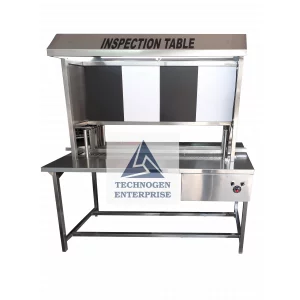


Manual Vial And Bottle Inspection Conveyor Details
Visual inspection remains a critical quality assurance step in pharmaceutical and injectable manufacturing, particularly where human judgement is required to identify subtle particulate contamination or cosmetic defects. A Manual Vial And Bottle Inspection Conveyor provides a structured, ergonomic, and compliant platform for performing these inspections efficiently.
Across United Kingdom—especially in pharmaceutical and life sciences hubs such as London, Cambridge, Oxford, Manchester, Birmingham, and the wider Midlands—manufacturers rely on dependable manual inspection systems to support batch integrity, regulatory compliance, and audit readiness. The inspection conveyor from Technogen Enterprise is engineered to meet these practical production requirements with reliability and simplicity.
What Is a Manual Vial And Bottle Inspection Conveyor?
A Manual Vial And Bottle Inspection Conveyor is a human-operated visual inspection system designed to examine filled vials and bottles for visible impurities. The machine facilitates inspection by providing controlled illumination, contrasting backgrounds, and organised material flow.
It is typically installed between upstream filling machines and downstream packaging equipment, forming a vital link in the pharmaceutical quality control process. This system is widely used where regulatory protocols mandate human visual verification rather than fully automated inspection.
Working Principle of the Manual Vial and Bottle Inspection Conveyor
The inspection process is straightforward, operator-friendly, and optimised for consistent throughput:
Infeed from Upstream Equipment
Filled vials or bottles are transferred onto the central conveyor section from the filling line.Visual Inspection Zone
Operators seated along the conveyor inspect containers against black and white inspection boards with suitable illumination to detect particles, fibres, or cosmetic defects.Three-Partition Conveyor Layout
The central conveyor carries incoming containers for inspection
The side conveyors transport accepted containers toward downstream processes
Manual Sorting
Defective containers are manually removed by the operator, while accepted units continue along the conveyor.Transfer to Downstream Equipment
Inspected vials and bottles move seamlessly to labelling, packaging, or further processing stages.
This layout ensures inspection accuracy while maintaining an organised and continuous workflow.
Key Features of the Manual Vial And Bottle Inspection Conveyor
The following features are rewritten strictly from the provided inputs for clarity and professional flow:
CGMP-Compliant Modular Design
Supports pharmaceutical manufacturing standards and flexible installation layouts.Black and White Inspection Boards
Enables clear visibility of a wide variety of impurities during inspection.Stainless Steel Construction
Provides durability, hygiene, and long service life in regulated environments.No Format Change Parts Required
Allows inspection of different vial and bottle sizes without mechanical changeover.Trouble-Free Operation
Simple mechanical design ensures ease of use for operators.Low Maintenance Requirement
Designed to be nearly maintenance-free under normal operating conditions.Multiple Seating Configurations Available
Models are available based on operator seating arrangements to match production needs.
Technical Specifications
All specifications below are reproduced exactly from the provided source and formatted for buyer clarity.
| Model | TGVIC-60 | TGVIC-100 | TGVIC-150 | TGVIC-200 | TGVIC-250 |
|---|---|---|---|---|---|
| Operator Seating | 2 | 4 | 6 | 8 | 10 |
| Power Consumption | 0.5 HP | 0.5 HP | 0.75 HP | 0.75 HP | 1 HP |
| Dimensions (L × W × H) mm | 1300 × 765 × 1530 | 1900 × 765 × 1530 | 2550 × 765 × 1530 | 3100 × 765 × 1530 | 3700 × 765 × 1530 |
| Direction | Left to Right | Left to Right | Left to Right | Left to Right | Left to Right |
| Electrical Connection | 415V, 3 Phase, 4-wire, 50 Hz | Same | Same | Same | Same |
Applications & Industries
The Manual Vial And Bottle Inspection Conveyor is widely used in:
Pharmaceutical manufacturing plants
Injectable and parenteral production units
Liquid oral formulation facilities
Contract manufacturing organisations (CMOs)
Pharmaceutical clusters across United Kingdom, including Cambridge–Oxford life sciences corridors, London-based formulation plants, and manufacturing units in Manchester, Leeds, Nottingham, and Birmingham, rely on such inspection conveyors to maintain consistent quality control.
Advantages & Buyer Benefits
For production managers, QA heads, and compliance teams, this inspection conveyor delivers practical benefits:
Reliable human visual inspection support
Improved defect detection through controlled lighting
Flexible handling of multiple container sizes
Reduced downtime due to zero format changeover
Ergonomic seating arrangements for operators
Low operating and maintenance costs
Seamless integration into existing inspection lines
These advantages help maintain inspection accuracy without unnecessary automation complexity.
Why Choose Technogen Enterprise
Technogen Enterprise designs inspection equipment based on real pharmaceutical shop-floor requirements:
Proven expertise in pharmaceutical inspection machinery
CGMP-oriented construction and layout
Robust stainless-steel fabrication
Modular designs adaptable to different plant sizes
Export-grade manufacturing standards
Responsive technical and after-sales support
Pharmaceutical manufacturers across United Kingdom trust Technogen Enterprise for dependable inspection conveyors that support regulatory compliance and operational efficiency.
Frequently Asked Questions (FAQs)
1. What types of containers can be inspected on this conveyor?
Filled vials and bottles of various sizes can be inspected without format change parts.
2. Is the inspection fully manual?
Yes, inspection is performed visually by operators with machine-assisted lighting and layout.
3. How many operators can work on the conveyor?
Models are available for 2, 4, 6, 8, or 10 operators depending on production needs.
4. Does the machine require frequent maintenance?
No, it is designed to be nearly maintenance-free.
5. Is the conveyor suitable for pharmaceutical plants in United Kingdom?
Yes, it is designed for pharmaceutical and injectable facilities across United Kingdom.
Related Products
Ampoule Visual Inspection Machine
In pharmaceutical and injectable manufacturing, visual inspection is a critical quality control step that directly impac... Continue