Automatic External Ampoule Washing Machine Manufacturer & Supplier In United Kingdom
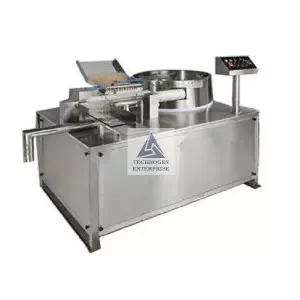

Automatic External Ampoule Washing Machine Details
In injectable pharmaceutical manufacturing, external cleanliness of ampoules is critical before sterilisation, inspection, and secondary packaging. Residual moisture, dust, or handling marks on ampoule surfaces can compromise downstream processes and regulatory compliance. An Automatic External Ampoule Washing Machine is therefore an essential utility for GMP-compliant injectable facilities.
Pharmaceutical plants operating across Cambridge, Stevenage, London, and the wider South-East life sciences corridor, as well as high-volume manufacturing units in Manchester and the Midlands, rely on dedicated external ampoule washing systems to maintain consistent container hygiene at production scale.
What Is an Automatic External Ampoule Washing Machine?
An Automatic External Ampoule Washing Machine is a rotary continuous-motion system designed exclusively to wash the outer surface of sealed ampoules. Unlike internal washing equipment, this machine focuses on removing external contaminants generated during filling, sealing, tray handling, or storage.
The system processes ampoules through controlled washing and drying stages, ensuring the container exits completely dry and ready for inspection or sterilisation tunnels.
Working Principle (Step-by-Step)
Tray-Based Loading
Ampoules are manually loaded into trays at the infeed section.Feed Worm Spacing
A precision feed worm spaces ampoules uniformly before washing.Primary External Washing
Ampoules enter the rotating wheel where the first washing station applies tap water or optional detergent for heavy contamination.Secondary Rinse Washing
A second tap-water wash removes residual detergent and surface impurities.Drying Stations
At the exit feed worm, combined dry air and hot air stations eliminate moisture from the ampoule surface.Discharge
Clean, dry ampoules exit the machine for downstream inspection or sterilisation.
This rotary sequence ensures consistent washing quality without interrupting production flow.
Key Features
CGMP-compliant machine design
Machine body manufactured from AISI 304 stainless steel
Worm gearbox with gear motor for main drive
Tray-based loading and unloading system
Four-stage external washing sequence
Two SS 316L tanks (50-litre capacity) with horizontal multistage centrifugal pumps
Variable frequency drive for precise speed regulation
Technical Specifications
| Parameter | Specification |
|---|---|
| Model | TGAW-250RE |
| Output | Up to 250 CPM (1–5 ml ampoules, dirt dependent) |
| Ampoule Size | 1 ml to 5 ml (with change parts) |
| Tanks | 2 × SS 316L, 50 litres |
| Pumps | 2 horizontal multistage centrifugal pumps |
| Blower | 1 No. |
| Heater Block | 3 heaters × 1 kW each |
| Dimensions (L × W × H) | 1450 × 1400 × 1450 mm |
| Loading / Unloading | Tray |
Applications & Industries
This machine is widely used in:
Injectable pharmaceutical formulation plants
Ampoule filling and sealing lines
Sterile manufacturing facilities
It is particularly relevant for pharmaceutical operations serving regulated healthcare markets from UK manufacturing hubs such as the Midlands, Northern England, and the South-East pharmaceutical belt.
Advantages & Buyer Benefits
Dedicated external surface cleaning without internal contact
Continuous rotary motion for stable, high-throughput operation
Effective moisture removal through hot air drying
Compact footprint suitable for space-constrained cleanrooms
Low maintenance with robust mechanical construction
Why Choose Technogen Enterprise
Technogen Enterprise designs ampoule washing machines aligned with real pharmaceutical production environments:
Proven expertise in injectable handling equipment
Hygienic material construction using SS 304 / SS 316L
Export-grade manufacturing standards
Reliable performance for continuous operation
Trusted by pharmaceutical manufacturers supplying United Kingdom’s regulated markets
Frequently Asked Questions (FAQs)
1. Does this machine wash the inside of ampoules?
No, it is designed exclusively for external ampoule washing.
2. Can detergent washing be used?
Yes, detergent washing is available as an option for heavily soiled ampoules.
3. What output can be achieved?
Up to 250 ampoules per minute for 1–5 ml sizes, depending on contamination level.
4. Is the machine suitable for pharmaceutical GMP environments?
Yes, it is designed as a CGMP-compliant model.
5. Can this machine integrate with sterilisation tunnels?
Yes, cleaned ampoules can be directly transferred to inspection or sterilisation equipment.
Related Products
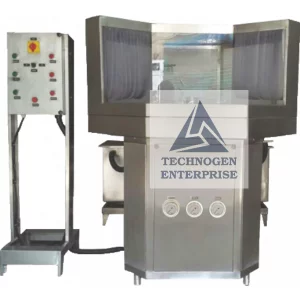
Semi Automatic Rotary Bottle Washing Machine
For small to medium-scale manufacturing units, bottle washing efficiency directly influences downstream filling quality ... Continue
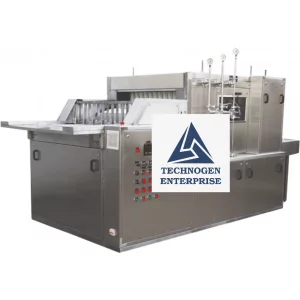
Automatic Tunnel Type Linear Vial Washing Machine
In sterile pharmaceutical and injectable manufacturing, vial washing is a non-negotiable process that directly impacts p... Continue
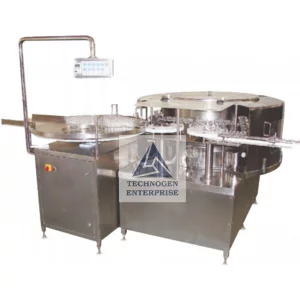
Automatic Rotary Vial Washing Machine
High-speed injectable manufacturing lines demand washing systems that combine precision, hygiene, and uninterrupted thro... Continue
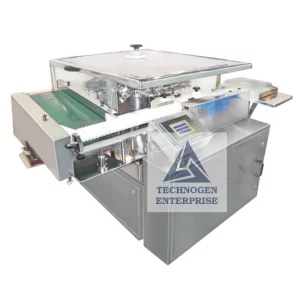
Automatic Rotary Ampoule Washing Machine
In sterile pharmaceutical manufacturing, ampoule washing is a critical upstream operation that directly affects product ... Continue
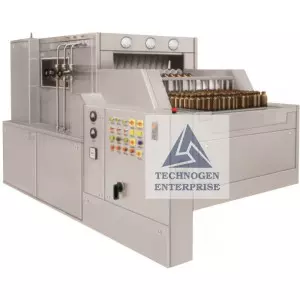
Automatic Tunnel Type Linear Bottle Washing Machine
High-throughput pharmaceutical and cosmetic production lines demand reliable, continuous bottle washing with consistent ... Continue